

Remember the pandemic, when everything changed in an instant? What I remember most is how we changed, too. Some of us spent days freaking out about the “new normal” of masks, vaccines, and working from home. Others set about discovering how to take control of the situation and still thrive.
What was the difference between those approaches? Some people have learned that there’s no reason to be afraid of a “new normal.”
Ever.
Let me tell you a story.
Thanks for reading Always Inspiring, where one new idea could change your life. To support my work, consider upgrading to Insider and make inspiration part of your success plan for the whole year. If you like this week’s post, please give it a ❤️ too.
Lions, Tigers, and Real Estate Trends
When change occurs, people tend to see the problems rather than the possibilities.
We know intellectually that change is constant: Even though adaptability is our superpower as humans, the magic only happens when we see the ability to deal with those moments of life and change, for ourselves and our clients.
To the extent that we succeed, it is by turning cautions into calculated risks.
[download the ebook “8 Ways to Turn Cautions into Calculated Risks]
So new normals shouldn’t worry us.
For an industry that has undergone so much change in the last four decades, I’m amazed at the amount of hyperventilating about change that still happens. There’s never not been a change-boogeyman in our business. Or a lack of people proclaiming the arrival of some “new normal” that you just have to deal with or be eliminated.
Just think of all the things we’ve handled in the last four decades:
The advent of buyer agency
The arrival of MLS systems
The internet and social media
Banks, techbros and various other disintermediaries
For-Sale-By-Owner websites
Discount brokers, 100% commissions and pyramid-schemes
Real estate portals, data aggregators and internet scrapers
Private equity
The pandemic
Lawsuits
M&As
Artificial intelligence
And lots more.
Yet Each and Every Time
You dealt with those changes just fine.
Most “new normals” quickly became our new foundations for higher achievement. Today, we prospect FSBOs more easily because we can find them faster, now that they’re on the web. Buyer agency lawsuits upgraded the average income of thousands of agents compared to the old ways of being paid (and mostly not being paid). Techbros have introduced gadgets that are now considered ordinary. We even sold over six million homes during the pandemic!
We should probably love new normals, not fear them, by now.
Still, “Is this a new normal?” never fails to provoke anxiety, as in a post seen this week on Facebook….
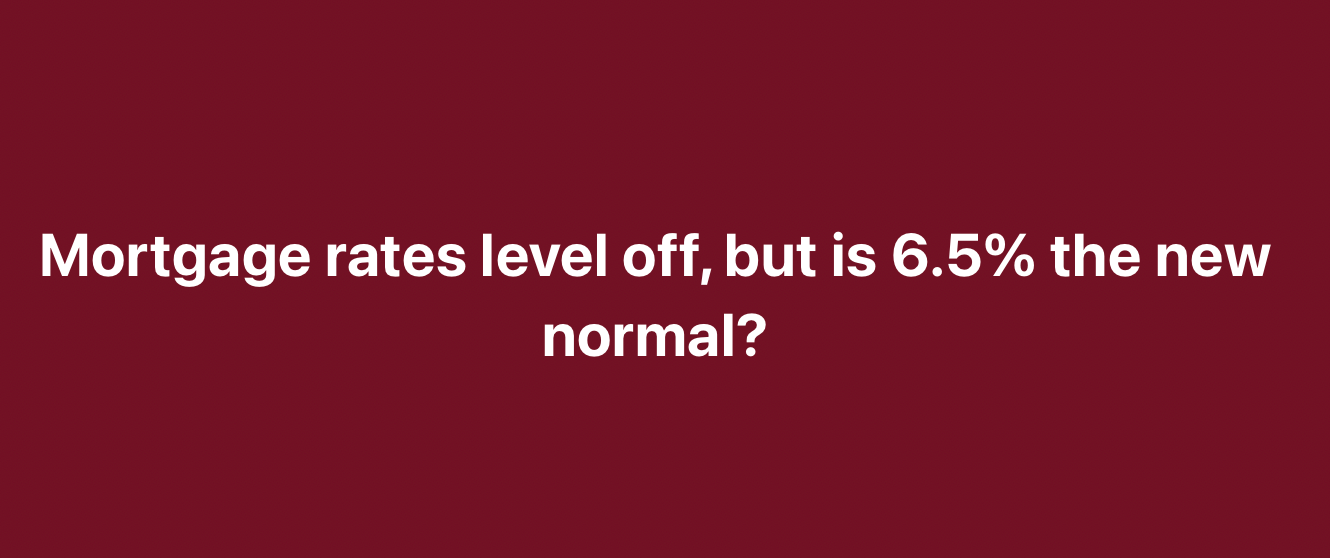
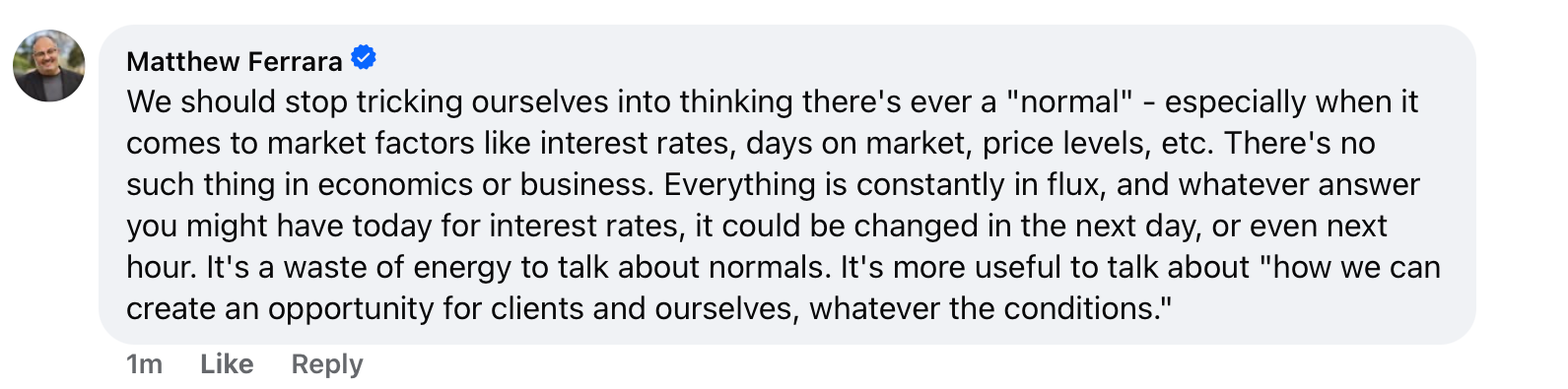
… which quickly sent dozens of people down the rabbit hole. Somehow they’d forgotten that interest rates change every hour of every day. Just the idea that there might be a new normal at a higher level sent people into a spin.
Looking back on it, I’m pleased with my immediate response:
Taming the Lions and Tigers and Trends
I recall a time when this would not have been my first reaction. More likely, I’d have obsessed about the new normal, too. So how did I come to see new normals as opportunities instead?
The short answer was learning to pay more respect to my abilities than my doubts.
The long answer requires a little story.
Early in my career, a REALTOR Association client called with a unique proposition:
“I heard that you are taking tech calls for some of our brokers. We want you to run a technical support hotline for our entire association. Want to do it?” she asked.
I was so surprised by the suggestion that I didn’t know what to say. So she continued, “That’s over 2000 members.”
“That’s impossible,” I immediately reacted. “We do training. We answer a few calls a day as a courtesy to a few brokers. We don’t know anything about running a full help desk!”
“Nothing yet,” she said. “But you could learn.”
Doubts flooded my mind. “I only have two employees. We’re open nine to five. You have 2000 members who could call about anything at any time!” I even said something silly like, “Besides, I only have a two-line phone system!”
“All true. But you could hire more people, expand hours, and install more phone lines,” my client laughed. “We’re willing to be your first customer to help you pay for it.”
“I don’t know,” I pushed back.
“Take a few days to figure it out, and call me back,” she said. She wasn’t taking no for an answer.
I hung up the phone and wanted to throw up.
A Scary New Normal?
I talked to my people about the proposal. None of us had ever thought about running a help desk. Or hiring more people, creating multiple shifts, or moving to a bigger office (which we’d eventually need). We had no idea how to do any of it, and it was very intimidating.
So I called my mentor. After listening carefully, he said, “There’s no evidence you can’t do it. What’s holding you back is just doubt.”
“I don’t understand,” I said.
“Doubts aren’t real. They’re imaginations, not data. Doubts make you think you’re avoiding danger when you are really missing an opportunity,” he tried again.
“But,” I said, “What if I fail?”
“What if you tried doubting your doubts instead? Since it’s equally possible that you could not fail. Set aside the doubt and explore the question: What if you succeed?”
The Power of Doubting Our Doubts
Doubts aren’t real. They’re simply possibilities.
And when faced with a new situation, it’s just as likely you’ll succeed as you might fail. Most people think doubts somehow point out real dangers. But often that’s not what they’re doing at all: because doubts aren’t data, they are a defense mechanism.
Over time, I’ve trained myself to doubt my doubts, rather than my abilities, when facing a change. When we give ourselves permission to expect success rather than failure, we become open to actions. We give more attention — more power — to the likelihood of handling the change effectively.
By doubting doubts, we reframe new normals as signals of opportunity, rather than signs of trouble. That’s what makes it possible to turn new normals into new foundations for additional success.
Ten Years of Growth Instead
Two weeks after the initial call, we signed an agreement to build a help desk for the entire association. We still had a lot to figure out. But once we reframed our doubts with expectations of success, we started having a lot of fun shaping it. We experimented with new processes, explored new technology, and built habits that would become the foundations of more than ten years of future growth. In just a few months, we discovered we enjoyed the work very much: helping resolve dozens of calls a day was very rewarding!
“Glad you’re enjoying it,” said my client on our next status call. “Because I’ve already called the adjoining state association, and they want you to offer the service to their members, too. That’s another 2500 people for you. Think you can handle it?”
“No doubt,” I said with a smile.
Little did I know that setting aside my doubts would eventually lead to growing my company to handle tens of thousands of calls for hundreds of thousands of users each month, helping them succeed in their businesses, too! For the next ten years, growth, profitability, and fun were the new normal.
With nothing to fear.
So what could a new normal create for you, too?
—M
Four New Normals I Think You Should Explore Today
Here are four “new normals” in real estate you might challenge your doubts about and explore their signals for other kinds of growth. Let me know what you think in the comments. 👇


